
Two quotes for "the same" car seat foam program can look nearly identical on paper — same density number, same delivery date, same price per part — and still come from two very different businesses. One pours and molds its own polyurethane and can tell you exactly how the part will behave in year three. The other buys foam from someone else, sews or bonds it into shape, and is guessing along with you.
This guide is for OEM program buyers, Tier 2 seating suppliers, and aftermarket importers who need to qualify a car seat foam manufacturer before tooling money moves or a purchase order is cut. It covers how to tell a real molder from a reseller, which numbers to demand in writing, and the sequence for validating a sample before you commit to volume.
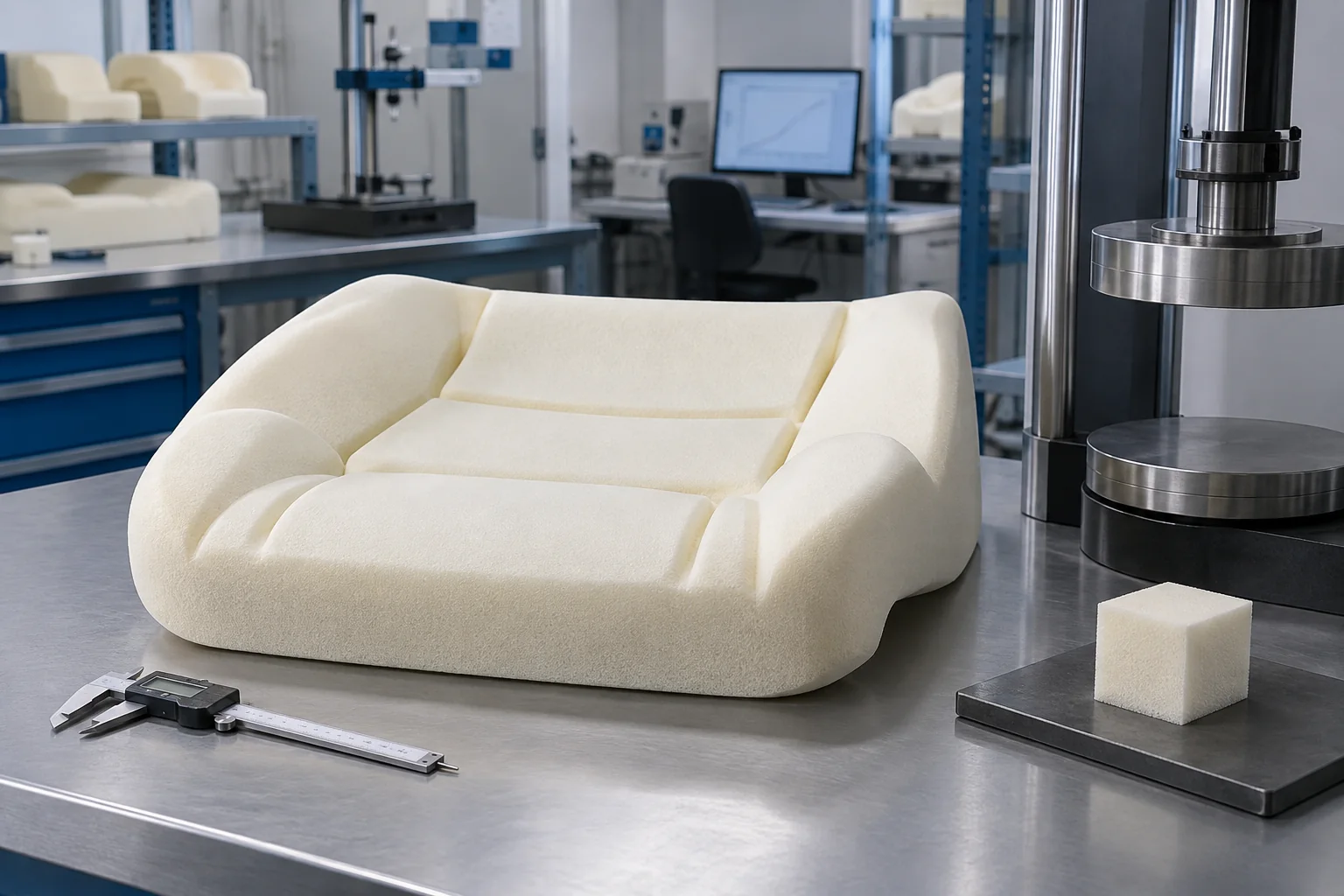
Manufacturer, molder, or trader — know who you're buying from
"Manufacturer" gets used loosely in automotive foam sourcing. Three different businesses answer to it, and which one you're talking to decides how much of your program's quality is actually under that supplier's control.
- Foam manufacturer / molder. Pours its own cold-cure HR (high-resilience) polyurethane and, for molded parts, owns or builds the tooling. Controls density, firmness, and cure — so it can quote a real specification and hold it across a production run.
- Cut-and-fabricate shop. Buys slabstock foam from a producer, then CNC-profiles or laminates it to shape. Controls the cut, not the underlying foam chemistry — if the upstream foam supplier changes formulation, the shop may not notice until a customer complains.
- Trader / sourcing agent. Owns no production. Places your order with a factory and adds a margin. Every technical question — density, compression set, a tooling change — has to travel through a middleman who cannot answer it directly.
None of these is automatically wrong to work with, but you need to know which one you have, because it determines who can actually answer "what's the compression set on this foam, and can you hold it batch to batch?" A trader will relay the question. A molder will read it off a datasheet.
The clarifying question: *"Do you pour and mold your own foam, or do you buy it and fabricate?"* A real manufacturer answers without hesitation and can usually describe its own cure cycle.
The numbers a real manufacturer can give you
If a quote describes the foam only in adjectives — "premium," "OEM-grade," "high support" — that is marketing, not a specification. A manufacturer that controls its own foam can give you figures, each tied to a test standard.
| Property | Typical automotive HR range | Test / standard |
|---|---|---|
| Density (molded HR) | 45–60 kg/m³ | ISO 845 |
| Density (budget slabstock) | 25–30 kg/m³ | ISO 845 |
| 25% IFD (firmness) | 200–350 N | ASTM D3574 Test B1 |
| Support factor | 2.6–3.0 | 65% ÷ 25% IFD |
| Compression set | under approx. 10% | ASTM D3574 Test D (50%, 70°C) |
| Flammability | ≤ 102 mm/min burn rate | FMVSS 302 / ISO 3795 |
Support factor is the number most quotes skip, and it is the one that predicts whether a seat still feels supportive after two years, not just on day one. A manufacturer that only quotes density and firmness — without support factor or compression set — has not given you a complete specification. Full methodology behind each figure is in our molded vs cut car seat foam guide.
Tooling and process capability
For a molded program specifically, ask for evidence, not assurances:
- Cycle time and tool count. A molder running production should be able to state typical demold time (cold-cure HR is usually in the 3–6 minute range on a production carousel) and how many cavities/tools they currently run — vague answers here usually mean the "molder" is actually subcontracting the mold step.
- Zoned firmness capability. Complex automotive seats often need multiple firmness zones (softer cushion, firmer bolster) built into a single pour. Ask whether this is done in one shot or by bonding separate pieces after the fact — both are valid, but you should know which one you're buying.
- Sample-to-production repeatability. A one-off sample proves the tool works. Ask what changes, if anything, between a first-article sample and part 10,000 off the same tool.
If your program is still cut/prototype foam rather than a committed mold, the same supplier should be able to CNC-profile a cushion from a drawing or a physical sample without new tooling — useful for locking a design before committing to a mold. The tradeoffs between the two processes, including where the cost lines cross, are covered in the molded vs cut comparison.
Compliance you should confirm before anything else
Flammability is a pass/fail gate, not a selling point. Every interior cushion must clear FMVSS 302 (US) or the equivalent ISO 3795 horizontal burn test at no more than 102 mm/min before comfort or price is even worth discussing. Ask for the actual test report, not just a line item on a spec sheet claiming compliance.
Beyond the foam itself, ask what quality management system the plant operates under (ISO 9001 at minimum; IATF 16949 is the automotive-specific standard many OEM programs require) and verify any certificate number directly with the issuing body's own database rather than trusting a PDF forwarded by the supplier. A manufacturer that is confident in its process will expect this question and answer it specifically — naming the standard and the certifying body, not just saying "we're certified."
How to run a sourcing trial before committing
- Confirm production type first. Establish whether the candidate molds/pours its own foam or fabricates from bought material — this determines everything else.
- Get the full spec in writing — density, IFD, support factor, and compression set, each with its test standard — before a sample is even made.
- Order a sample against that written spec, not against a verbal description from the sales call. Check the sample against the document.
- Ask how reorder consistency is controlled. The sample is the easy part; the real question is whether part 50,000 matches part 1.
- Confirm flammability test data for the specific foam grade you're buying, not a generic company-wide claim.
OEM and custom molding: extra questions
If you're commissioning a new molded design rather than sourcing an existing part:
- Who owns the tool? Clarify upfront whether the mold is built specifically for your design and who retains it if the relationship ends.
- What's the realistic timeline from drawing to first article? Tool build for cold-cure HR molds is commonly measured in weeks, not days — get the actual number in writing for your specific geometry.
- How is a design change handled once the tool exists? A recut or modified tool takes time and money; know the process before you need it.
FAQ
How do I know if a car seat foam supplier actually manufactures the foam? Ask directly whether they pour/mold their own polyurethane or buy foam and fabricate it. A real manufacturer can quote density, IFD, support factor, and compression set with test standards, and can describe its own cure cycle. A trader or fabricator will answer in adjectives or relay the question to someone else.
What specifications should an OEM car seat foam manufacturer provide? At minimum: density (kg/m³), 25% IFD (N), support factor, compression set (%), and flammability test results (FMVSS 302 / ISO 3795), each tied to its test standard — not just adjectives like "firm" or "premium."
Do I need a mold for a new car seat foam program? Only if you're producing the same design in real, repeating volume with a complex shape. For prototypes, aftermarket, or a design that's still moving, cut/contoured foam avoids tooling lead time. See our molded vs cut decision framework.
How do I verify a manufacturer's quality certification? Ask for the certificate number and the issuing body, then check it directly on that body's own public database rather than relying on a PDF the supplier sends. ISO 9001 confirms process management; IATF 16949 is the automotive-specific standard many OEM programs require.
Can a manufacturer reproduce our existing seat cushion from a sample? Yes — a real molder can build a tool from a sample or drawing, and a cut-foam shop can CNC-profile one directly. Provide density and IFD targets alongside the shape, not just the shape, so the replacement performs like the original.
Talk to a foam engineer
If you're qualifying a car seat foam supplier and need density, IFD, and support-factor data you can verify — or a sample matched to a written specification — contact our team. We mold and cut our own polyurethane foam and can work from your drawing, sample, or performance spec.
*Miku Foam manufactures automotive car seat foam — molded and cut — for OEM, Tier 2, and aftermarket seating programs. See our car seat foam specifications hub, the molded vs cut decision guide, or contact us for specifications and samples.*