
Not every part sold as a "jounce bumper" is built from the same material, tested the same way, or backed by the same quality system. Two suppliers can quote what looks like the same suspension bump stop — similar dimensions, similar price — and one is a certified microcellular polyurethane part validated to hundreds of thousands of load cycles, while the other is molded from generic PU or solid rubber and has never seen a fatigue test rig.
This guide is for distributors, Tier 2 suspension suppliers, and aftermarket buyers who need to qualify a jounce bumper manufacturer before committing to volume — what "manufacturer" actually means in this trade, which numbers to demand, and how to verify the certifications a supplier claims.
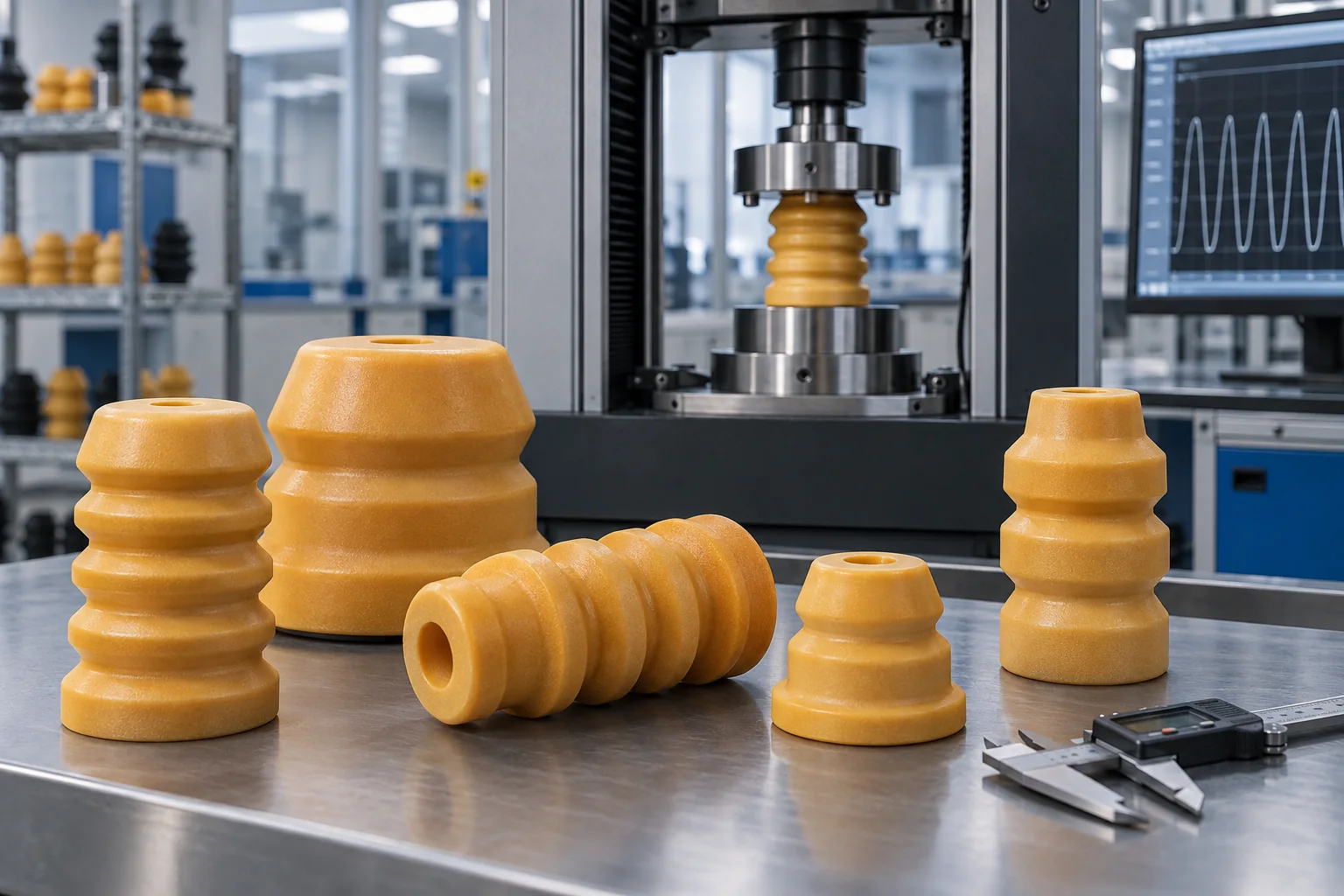
What are you actually buying — molded PU, or something sold as equivalent?
"Jounce bumper" and "bump stop" describe the function (limiting suspension travel and absorbing impact energy at the end of the stroke), not a specific material. That gap gets exploited.
- NDI microcellular PU manufacturer. Molds naphthalene diisocyanate (NDI)-based microcellular polyurethane, the premium chemistry for this part, chosen for its progressive load curve, long fatigue life, and temperature stability. Controls density grade and load curve at the source.
- Generic PU or MDI/TDI molder. Produces a visually similar polyurethane part on standard chemistry, without the fatigue and temperature performance NDI microcellular PU is specifically formulated for. May not disclose the difference unless asked directly.
- Rubber part sold as a "bump stop equivalent." Cheaper, but behaves differently under load — rubber typically gives a harder, more linear stiffness curve and shorter service life under repeated impact than microcellular PU.
The clarifying question: *"Is this NDI microcellular polyurethane, and can you show me the density grade and a fatigue test report?"* A real manufacturer answers immediately with a grade number and a document. A reseller of a generic part usually can't.
The numbers a real manufacturer can give you
| Property | What a real spec looks like |
|---|---|
| Chemistry | NDI microcellular polyurethane, stated explicitly (not just "PU") |
| Density grade | A specific figure, e.g. 0.35 / 0.45 / 0.55 / 0.65 g/cm³ — matched to load requirement |
| Load curve | Non-linear, progressive — described or shown as a static stiffness curve |
| Fatigue life | A real cycle-test report: cycle count, frequency, displacement range, height loss at end of test |
| Operating temperature | A stated continuous range (NDI microcellular PU typically holds performance from roughly −40°C to +120°C) |
| Compression set | Tested per ASTM D395, not just claimed |
| Quality system | A named standard (IATF 16949 or ISO 9001) with a certificate number you can verify independently |
A supplier who answers all seven with specifics, unprompted, is behaving like a manufacturer. A supplier who answers with "heavy duty" and "long lasting" is behaving like a reseller.
Fatigue testing is the number that separates real from generic
Anyone can publish a density figure. What separates an industrial-grade jounce bumper from a generic molded part is whether it has actually been cycled under load and measured for how much it permanently compresses afterward. A credible test report states the cycle count, the displacement range, the test frequency, and the resulting height loss — for example, a part validated to 500,000 cycles with height loss held to roughly 5–6% against a 10% pass/fail line has demonstrated it keeps its geometry, and therefore its ride behavior, over a long service life. Ask for the report itself, not a summary line on a datasheet.
Verifying an IATF 16949 certificate
IATF 16949 is the automotive industry's quality management standard, and it is significantly more rigorous than ISO 9001 — it requires statistical process control, APQP, and PPAP discipline, so part-to-part consistency is built into the process rather than caught at final inspection. It also means a great deal more than ISO 9001 for a part that has to perform identically across a production run.
Before accepting a certificate as proof of anything:
- Get the certificate number, not just a logo on a webpage or a photo of a plaque.
- Verify it independently through the certifying body's own public database — do not rely solely on a PDF the supplier forwards.
- Confirm the certificate covers the actual plant producing your part, not a parent company or a different facility.
Sourcing trial sequence
- Confirm the chemistry and get the density grade in writing before anything else — NDI microcellular PU, with a specific g/cm³ figure.
- Request the fatigue test report and compression-set data, not a datasheet summary.
- Verify the quality certificate at the issuing body directly.
- Order a sample and bench-test it yourself against the claimed load curve before committing to volume — a sample box that lets you run your own test is a reasonable ask of any real manufacturer.
- Ask how batch-to-batch consistency is controlled once you move from sample to production quantities.
Custom, private label, and ODM: extra questions
Distributors building a private-label program, or OEM buyers needing a custom density grade, should confirm:
- Which density grades are available, and whether a grade outside the standard lineup can be developed for your load requirement.
- What traceability comes with private label product — for example, whether the quality certificate number carries through to the packaging insert so your customers can verify it themselves.
- What the minimum order quantity is for a private-label SKU, and what replenishment lead time looks like once that first order ships — get both in writing before building a launch plan around them.
FAQ
How do I know if a jounce bumper is real NDI microcellular PU? Ask directly and request the density grade in writing (typically in the 0.35–0.65 g/cm³ range for this part type) along with a fatigue test report. A manufacturer that molds its own NDI microcellular PU answers immediately with specifics; a reseller of a generic PU or rubber part usually cannot.
What test data should a jounce bumper manufacturer provide? A real cycle-test report (cycle count, frequency, displacement range, and resulting height loss), compression-set data per ASTM D395, and a stated continuous operating-temperature range. A datasheet with only a density number and no test report is incomplete.
How do I verify a supplier's IATF 16949 certificate? Get the certificate number and check it directly against the certifying body's own public database — don't rely only on a PDF or logo the supplier sends. Confirm the certificate covers the specific plant producing your part.
Can I get a jounce bumper manufacturer to do private label? Many can. Confirm which density grades are available or can be developed for your load case, whether certificate traceability carries through to your packaging, and the minimum order quantity and lead time in writing before planning a launch.
Why choose NDI microcellular PU over rubber for a bump stop? NDI microcellular PU offers a progressive, non-linear load curve, longer fatigue life, and a wider operating temperature range than rubber in the same application. See our full materials comparison for the underlying reasons.
Talk to a jounce bumper manufacturer
If you're qualifying a jounce bumper supplier and want density, fatigue, and certificate data you can verify — or a sample to bench-test yourself — contact our team. We manufacture NDI microcellular PU jounce bumpers through our IATF 16949 certified partner facility and can supply test reports and sample units before you commit to volume.
*Miku Foam manufactures NDI microcellular PU jounce bumpers through an IATF 16949 certified partner factory (certificate # 0552607). See our jounce bumper specifications hub, the full fatigue and compliance test data, or contact us for specifications and samples.*