
A spec sheet with one number on it is not a specification — it's a marketing claim wearing a table format. Most car seat foam datasheets lead with firmness ("medium-firm," "300 N") because that's the number a buyer notices in a showroom sample. But firmness alone tells you almost nothing about whether a cushion will still feel right after two years of daily use. This guide walks through the numbers that actually matter, in the order you should check them, so you can tell a real spec sheet from a padded one.
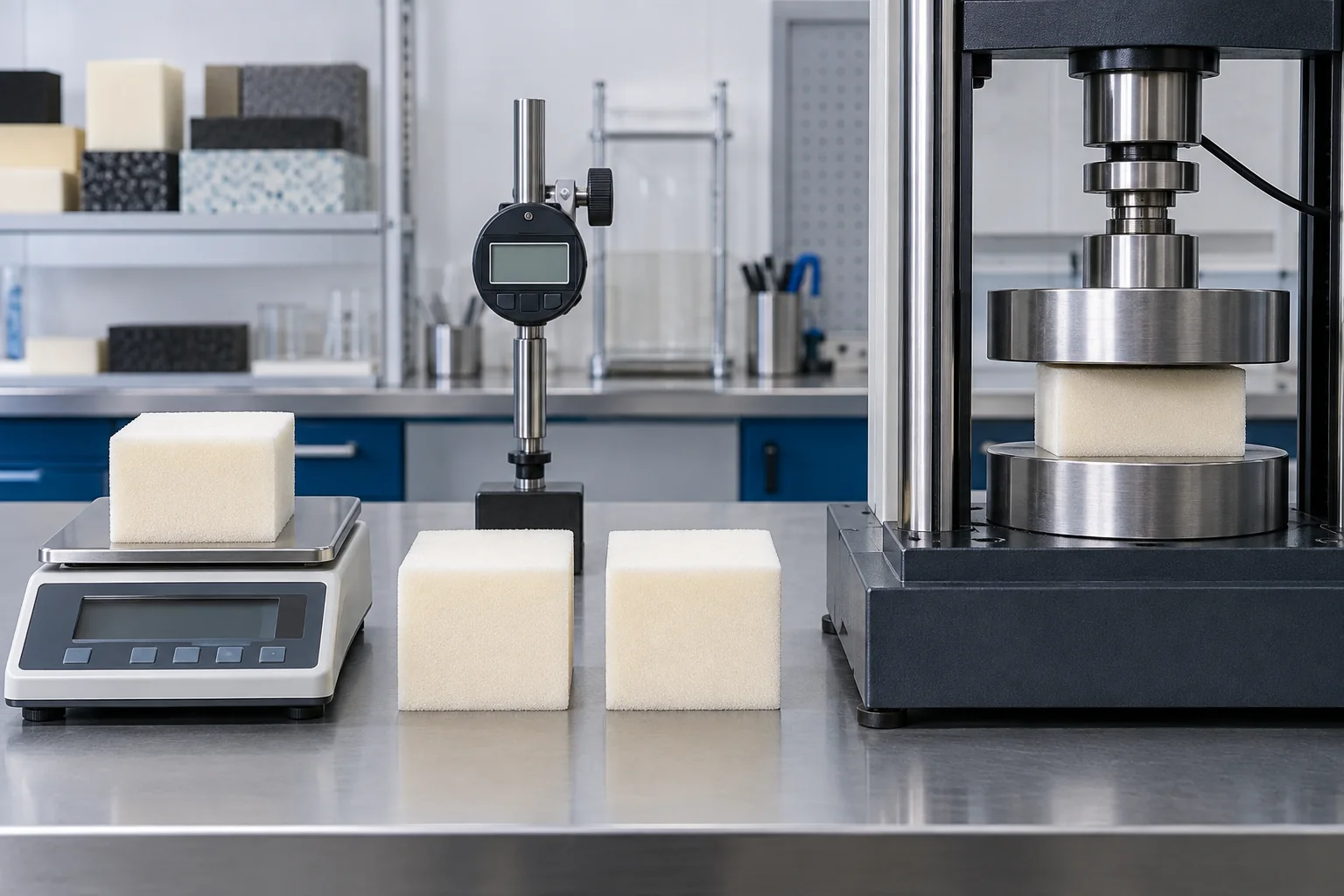
The three numbers, and what each one actually measures
Density (kg/m³) is the amount of polyurethane packed into the foam. It is the single best predictor of how long a cushion holds its shape — not how it feels new. Automotive HR (high-resilience) cushions typically run 45–60 kg/m³; budget slabstock can be as low as 25–30 kg/m³. Density is measured to ISO 845.
25% IFD — indentation force deflection (N) is how much force it takes to press the foam down by 25 percent of its thickness. This is the firmness a sitter actually feels first. Automotive cushions normally land between 200 and 350 N — soft enough for comfort on first sit, firm enough not to collapse. It's measured per ASTM D3574 Test B1.
Support factor is the ratio of force at 65% compression to force at 25% compression. In plain terms: does the foam keep pushing back as you sink further in, or does it give way and let you hit bottom? Good automotive HR foam sits around 2.6–3.0. Foam below roughly 2.0 is the seat that feels plush for the first inch of travel and then goes hard — it ran out of support.
The trap: density and IFD can be tuned somewhat independently. Two foams can quote the identical 250 N IFD — one at 50 kg/m³, one at 30 kg/m³ — and feel almost the same in a showroom sample. Only one of them is still a good seat in three years. Never accept an IFD number without a density number next to it, and never accept density without support factor.
The number most spec sheets leave out: compression set
Compression set (per ASTM D3574 Test D, typically run at 50% compression, 70°C) measures how much thickness the foam permanently loses after being held compressed under heat. A durable HR automotive cushion should stay under roughly 10% compression set. A low-density cushion can lose 15–25%, which shows up on the road as a seat that visibly sags, with bolsters that stop holding your body through a corner.
A spec sheet that quotes density and IFD but omits compression set has told you how the seat feels on day one and said nothing about whether it will still feel that way at 100,000 km.
Flammability: the gate before any of this matters
Before density, IFD, or support factor are worth discussing, every interior cushion has to clear a burn-rate test: FMVSS 302 in the US, or the equivalent ISO 3795 horizontal burn test, at no more than 102 mm/min. This is pass/fail, not a comfort spec — a foam that fails cannot be installed regardless of how good its other numbers look. A real spec sheet states the test result, not just "meets flammability standards."
A spec sheet at a glance
| Property | What it tells you | Automotive HR range | Test standard |
|---|---|---|---|
| Density | Durability, service life | 45–60 kg/m³ | ISO 845 |
| 25% IFD | Firmness you feel | 200–350 N | ASTM D3574 Test B1 |
| Support factor | Whether it keeps supporting as you sink in | 2.6–3.0 | 65% ÷ 25% IFD |
| Compression set | Permanent shape loss under heat/load | under ~10% | ASTM D3574 Test D (50%, 70°C) |
| Flammability | Pass/fail safety gate | ≤ 102 mm/min | FMVSS 302 / ISO 3795 |
Two more figures are worth asking for if your program ships to a hot-humid climate or needs a long fatigue life: wet (humid-aged) compression set (per ISO 13362 / humid aging protocols — foam that passes dry can still soften after humid aging) and fatigue/roller-shear resistance, which catches foam that passes a static compression-set test but softens under real, repeated in-and-out use. Neither shows up on a basic datasheet, so you have to ask.
Red flags in a spec sheet
- Only one number quoted (usually IFD/firmness) with no density, support factor, or compression set alongside it.
- Ranges with no test standard cited — "firm," "medium-firm," or a number with no ASTM/ISO reference attached.
- No flammability result for the specific foam grade — a general "we comply with FMVSS 302" statement without a report for the actual product you're buying.
- No compression set data at all. This is the figure most often missing, and its absence is usually not an oversight — it's the number that would reveal a cheaper foam's weakness.
How to use this when comparing suppliers
Ask every candidate for density, 25% IFD, support factor, and compression set on the same document, each with its test standard, for the exact foam grade you'd be buying — not a general company brochure. A supplier that pours and molds its own foam should produce this without delay; one that resells foam from someone else often cannot, because the number was never theirs to measure. For the fuller picture of how process choice (molded vs cut) interacts with these numbers, see our molded vs cut car seat foam guide; for a buyer-side checklist on vetting the manufacturer itself, see how to vet an OEM car seat foam manufacturer.
FAQ
What density should car seat foam be? For a primary automotive cushion, HR foam in the 45–60 kg/m³ range balances comfort and durability. Below roughly 40 kg/m³ is typically where sag and compression set begin, regardless of how firm the foam feels new.
What's the difference between IFD and density? IFD (indentation force deflection) is the firmness you feel when you press on the foam. Density is how much material is packed into it, and is the better predictor of how long the foam lasts. The two can be tuned somewhat independently, so ask for both — never one without the other.
What is support factor and why does it matter? Support factor is the ratio of force at 65% compression to force at 25% compression. A high support factor (2.6–3.0 for good automotive HR foam) means the foam keeps supporting you as you sink in, rather than collapsing once you're past the first inch of travel.
Why isn't compression set on most spec sheets? It's the figure that most clearly separates a durable foam from a cheaper one that looks similar on day one, so suppliers who haven't tested for it — or don't want to publish a poor result — often omit it. Ask for it directly; a real manufacturer that pours its own foam can produce it.
Does car seat foam have to pass a flammability test? Yes. Interior cushion foam must clear FMVSS 302 (US) or the equivalent ISO 3795 burn-rate test at no more than 102 mm/min before any other specification is worth discussing.
Talk to a foam engineer
If you have a spec sheet you want a second opinion on, or need density, IFD, and support-factor data with test standards for your own program, contact our team. We mold and cut our own polyurethane foam and can supply test data and sample units.
*Miku Foam manufactures automotive car seat foam — molded and cut — for OEM, Tier 2, and aftermarket seating. See our car seat foam specifications hub, how to vet a manufacturer, or contact us for specifications and samples.*