
Choosing a manufacturer is only half the job. Once you've picked a supplier, the next failure point is different: two people can agree a private-label order is "custom density, medium-firm, with your logo on the box" and walk away with completely different expectations of what that means. The order ships, the sample felt right, and the bulk shipment doesn't match it — not because the factory cut corners, but because nothing specific was ever written down.
This guide is for brands and distributors placing a private-label or custom-density memory foam pillow order who already have a manufacturer in mind (if you're still choosing one, see our manufacturer vetting checklist first). It covers exactly what to put in writing before a purchase order is signed.
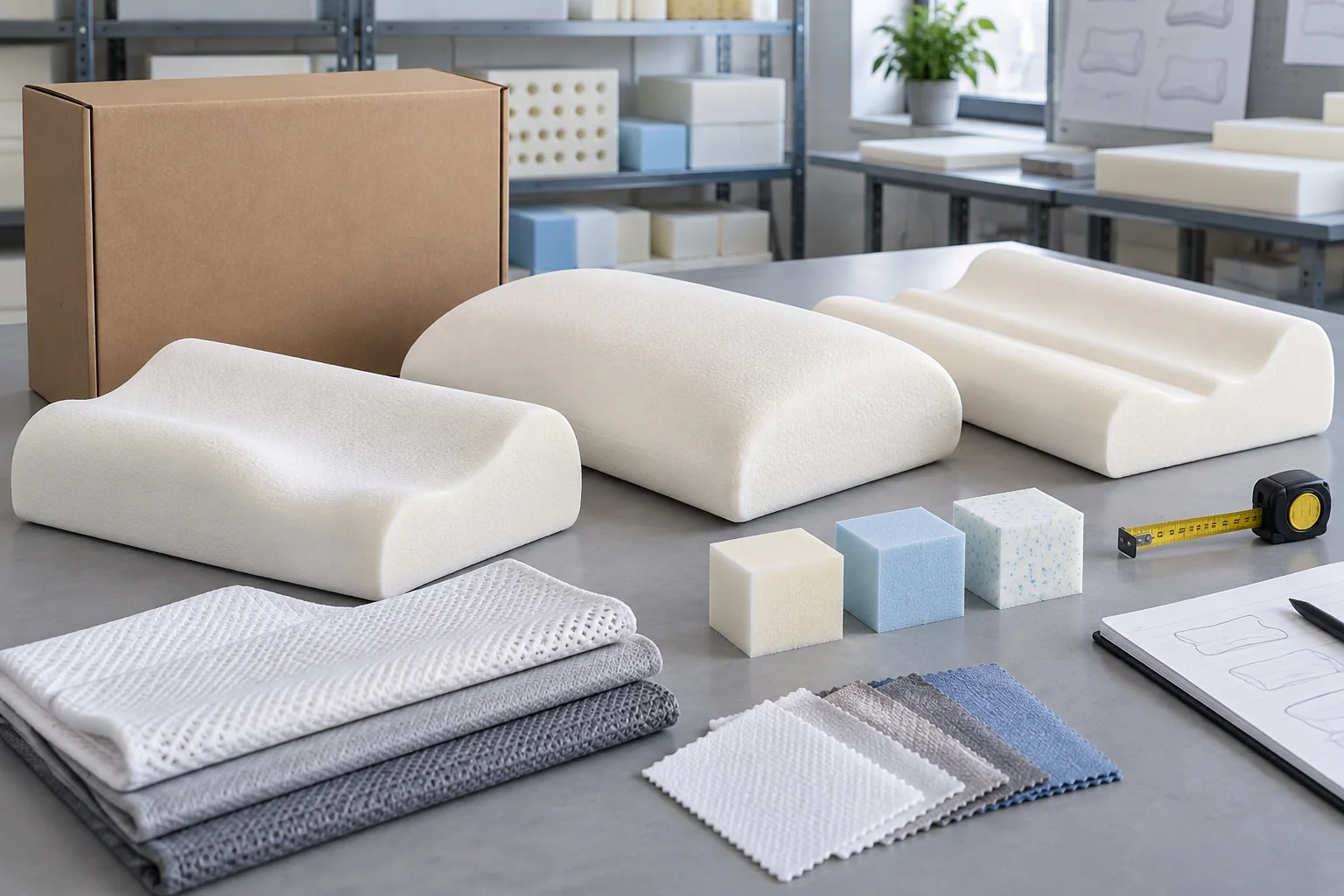
Density and firmness: write the numbers, not the adjectives
"Custom density" is a request, not a specification. Before you order:
- State the target density in kg/m³, not "firm" or "plush." Memory foam pillows commonly run 40–80 kg/m³; a manufacturer that pours its own foam can hit a specific figure within that range and hold it batch to batch.
- State firmness separately, as ILD/IFD. Density and firmness are not the same axis — two pillows can share a density and still feel different, or share a firmness and have very different lifespans. Specify both.
- Get both figures, and the test standards used (ISO 2439 / ASTM D3574 for firmness, ISO 845 for density), written into the purchase agreement, not just the sample confirmation email. A written spec is what protects you if a later production run drifts from the sample.
Contour shape and mold ownership
If your private-label product uses a molded contour shape rather than a simple cut block:
- Confirm whether a mold is being built specifically for your design. A contoured pillow requires tooling; a simple rectangular pillow may not.
- Clarify who owns that mold. If the relationship ends, does the tool stay with the factory, get destroyed, or come to you? Get this in writing before the mold is cut, not after.
- Ask what changing the shape later costs. A tooling revision takes time and money — know the process and rough timeline before you need it.
Cover, packaging, and private-label branding
Private label usually touches more than the foam itself. Specify each of these separately, since a supplier may treat some as standard and others as custom (with different cost and lead-time impact):
- Cover fabric — material, and whether it's removable/washable.
- Printed inserts or woven labels — your logo or brand name, and where it can physically go (sewn label vs. printed box vs. both).
- Outer carton marking — what appears on the shipping carton itself, which matters if your buyers or customs brokers expect specific markings.
- Compression and packaging format — memory foam pillows are typically roll-compressed and vacuum-packed for freight efficiency; confirm the packed dimensions match your freight math, and ask how long the pillow can remain compressed before recovery is affected.
Foam density and firmness, cover fabric, contour shape, and packaging are all commonly adjustable in a private-label program — but each has its own minimum and lead-time impact. Get the specific list of what's open and what each option costs in time, rather than assuming everything is equally flexible.
Certifications: state the requirement before sampling, not after
If your market or retail channel requires specific certifications, say so before the first sample is made — reworking a certified-compliant sample after the fact costs time neither side planned for.
- CertiPUR-US — tests the foam itself for restricted substances and low VOC emissions. Verify any claimed certificate directly at certipur.us, since it's issued to a specific company and product line, not a general industry claim.
- OEKO-TEX Standard 100 — tests the cover fabric, not the foam. Relevant if your buyers care about the textile that touches skin.
- ISO 9001 — confirms the factory has documented, repeatable quality-management processes. It does not certify any property of the pillow itself.
State which of these (if any) your program requires as part of the initial brief, and ask the manufacturer to confirm — in writing — which of their existing certifications actually apply to the specific product line you're ordering, not just the company as a whole.
Sample approval: treat it as a document review, not a feel test
The sample stage is where most private-label misunderstandings could have been caught and usually aren't, because buyers approve on feel rather than against the written spec.
- Agree the full written spec first — density, firmness, contour, cover, packaging.
- Request the sample against that document, not a general "send me a sample."
- Check the sample against the spec sheet, not against memory of the sales call.
- Sign off in writing that the sample matches the agreed spec, so any later production drift has a clear reference point.
Lead time: get the full timeline before you build a launch calendar
Sampling, revision, and first production run each take real time, and a private-label program with a mold or custom packaging adds more steps than a standard reorder. Ask for the full sample-to-bulk timeline in writing, broken out by stage (initial sample, revision if needed, tooling if applicable, first production run), before you commit to a retail launch date or promise a delivery window to your own customers.
FAQ
What's the difference between density and firmness for a memory foam pillow? Density (kg/m³) is how much material is packed into the foam and is the better predictor of how long it lasts. Firmness (ILD/IFD) is how the pillow feels under pressure. The two can vary independently, so specify both separately, each with its test standard.
Do I need a mold for a custom private-label pillow shape? Only for a contoured or ergonomic shape rather than a simple rectangular block. If a mold is involved, clarify who owns it and what a future design change costs before the tool is built.
What should be written into a private-label purchase agreement? At minimum: target density and firmness with test standards, contour/mold ownership if applicable, cover fabric and packaging details, any required certifications for the specific product line, and the full sample-to-bulk lead time.
Which certifications actually apply to the foam versus the cover? CertiPUR-US covers the foam itself. OEKO-TEX Standard 100 covers the cover fabric. ISO 9001 covers the factory's quality-management process, not the product. Ask which certifications the manufacturer holds for the exact product line you're ordering, not just the company in general.
How do I avoid a bulk order that doesn't match the sample? Agree the full spec in writing before the sample is made, approve the sample against that document rather than by feel, and get written sign-off that the sample matches the spec. That document is your reference point if a later production run drifts.
Talk to a foam manufacturer
If you're specifying a private-label or custom-density memory foam pillow program and want density and firmness data you can verify — or a sample matched to a written spec — contact our team. We pour our own polyurethane foam and can work from your target density, firmness, and shape.
*Miku Foam manufactures memory foam and viscoelastic polyurethane foam products, including pillows and custom private-label programs. See our buyer's guide to memory foam pillows, how to vet a manufacturer, or contact us for specifications and samples.*